
1. Introduction: Why Offshore Containers Are Treated as Lifting Appliances
In offshore projects, containers are often misunderstood as simple storage units. In reality, offshore containers are engineered equipment that are repeatedly used in high-risk environments. This is why they are legally and technically treated as lifting appliances.
Offshore lifting operations involve cranes, vessels, dynamic motion, and personnel working nearby. Any failure during lifting can lead to serious safety incidents, equipment loss, and operational shutdowns. To manage this risk, offshore regulations classify equipment that is lifted with load as lifting appliances.
This classification is not optional. It exists to ensure safety, liability control, and regulatory compliance in offshore environments.
2. What Is a Lifting Appliance in Offshore Operations?
A lifting appliance is any equipment designed to lift, lower, or suspend loads during operations.
In offshore projects, lifting appliances include:
- Crane
- Lifting beams
- Spreader bars
- Rigging accessories
These items are designed, inspected, tested, and certified to ensure safe lifting under defined load conditions.
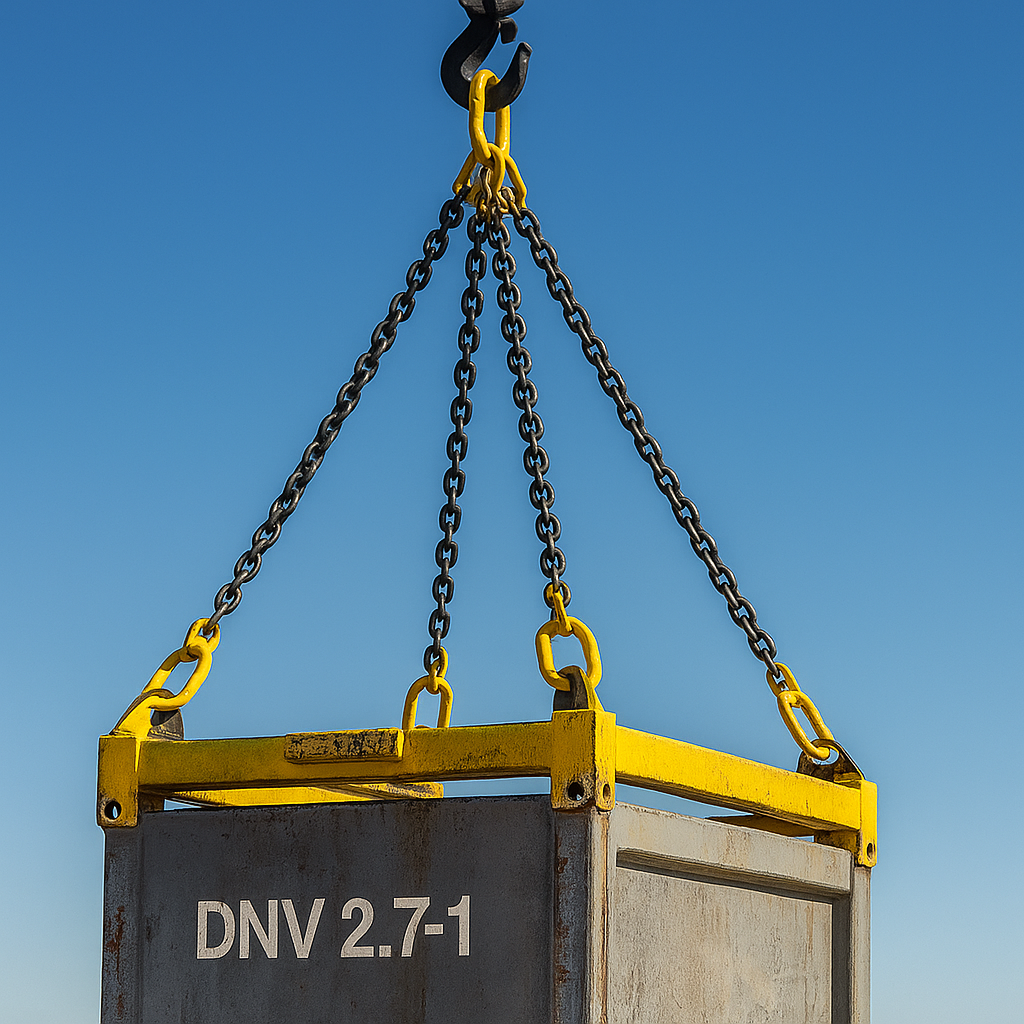
Offshore containers fall into this category because they are routinely lifted while carrying payload, using cranes and engineered lifting points.
3. Why Offshore Containers Are Classified as Lifting Appliances
3.1 Lifted While Fully Loaded
Unlike storage containers, offshore containers are lifted with payload inside.
This means:
- The crane lifts the self-weight + payload
- The load is defined by a Working Load Limit (WLL)
The container must safely transfer this load through its structure and lifting points without failure.
3.2 Exposure to Dynamic Offshore Loads
Offshore lifting is never static.
During lifting, containers are exposed to:
- Crane motion
- Vessel movement
- Wind, wave, and sea conditions
- Impact and shock loading
These dynamic loads significantly increase stress compared to onshore or static lifting. Containers must be designed to withstand these conditions safely.
3.3 Use of Engineered Lifting Points
Offshore containers are lifted using pad-eyes or lifting lugs welded into the structure.
Key considerations include:
- Sling angles
- Load distribution
- Clear load transfer paths
These lifting points are structural elements. Any weakness can result in sudden failure during lifting.
3.4 High-Consequence Failure Risk
Failure of an offshore container during lifting can lead to:
- Serious injury or loss of life
- Damage to expensive offshore equipment
- Operational downtime and vessel delays
Because the consequences are severe, offshore regulations demand higher safety standards.
4. Key Differences Between Offshore Containers and ISO Containers
Offshore containers are fundamentally different from ISO containers.
| Aspect | Offshore Containers | ISO Containers |
| Design intent | Offshore lifting & transport | Cargo storage |
| Lifting philosophy | Lifted with payload | Limited lifting |
| Structural margins | High safety margins | Lower margins |
| Certification | Mandatory offshore certification | Not offshore-rated |
Using ISO containers offshore without certification is a serious compliance violation.
5. Engineering Requirements for Lifting Appliance Classification
5.1 Structural Design & Load Path Analysis
Offshore container design includes:
- Analysis of primary and secondary structural members
- Identification of stress concentration zones
- Clear load paths from payload to lifting points
This ensures forces are safely distributed during lifting.
5.2 Design Margins & Safety Factors
Offshore containers require higher safety factors due to:
- Dynamic loading
- Environmental uncertainty
- Repeated lifting cycles
Designs must account for both static and dynamic loads, not just weight.
5.3 Welding & Fabrication Controls
Welding quality is critical.
Requirements include:
- Identifying critical weld zones
- Qualified welding procedures
- Certified welders
Poor welding is one of the most common failure causes in lifting equipment.
6. Inspection & Certification Requirements
Because offshore containers are lifting appliances, they must undergo:
- Third-party inspection
- Defined inspection hold points
- Proof load testing
- Acceptance against recognized standards
Certification confirms the container is safe for offshore lifting operations.
7. Documentation Required for Offshore Containers as Lifting Appliances
Typical documentation includes:
- Structural design calculations
- Material certificates
- Welding records
- Load test reports
- Final certification dossier
Without this documentation, offshore acceptance is not possible.
8. Operational Implications for Offshore Projects
Treating containers as lifting appliances means:
- They must be included in lifting plans
- They form part of HSE procedures
- They require periodic inspection and re-certification.
Responsibility lies with both owners and operators to ensure ongoing compliance.
9. Common Compliance Issues Identified During Inspection
Inspectors frequently identify:
- Incorrect lifting point design
- Missing or incomplete documentation
- Misinterpretation of container classification
- Use of non-certified containers offshore
These issues often lead to rejected equipment and project delays.
10. Impact on Project Planning & Lead Time
Lifting appliance classification increases lead time because of:
- Engineering requirements
- Inspection scheduling
- Certification reviews
Early supplier engagement is essential to:
- Avoid redesign
- Prevent inspection failures
- Reduce rework and delays
Proper planning saves time later.
11. Why Supplier Experience Matters
Experienced suppliers understand:
- Offshore lifting risks
- Inspection expectations
- Certification requirements
An inspection-ready design approach improves first-time pass rates and reduces project risk.
12. Why Al Basata Designs Offshore Containers as Lifting Appliances
Al Basata follows an engineering-first approach.
Key principles include:
- Design aligned with DNV and offshore standards
- Early inspection and certification planning
- Containers designed specifically for offshore lifting, not adapted later
This ensures compliance-ready solutions with predictable lead times.
14. Conclusion: Lifting Appliance Classification Is a Safety Requirement, Not a Choice
Offshore containers are treated as lifting appliances because they are lifted with load in high-risk environments. This classification exists to protect people, equipment, and offshore operations.
Compliance with lifting equipment standards is not a design preference — it is a safety and regulatory requirement. Understanding this early helps project teams plan better, reduce risk, and avoid costly delays in offshore projects.